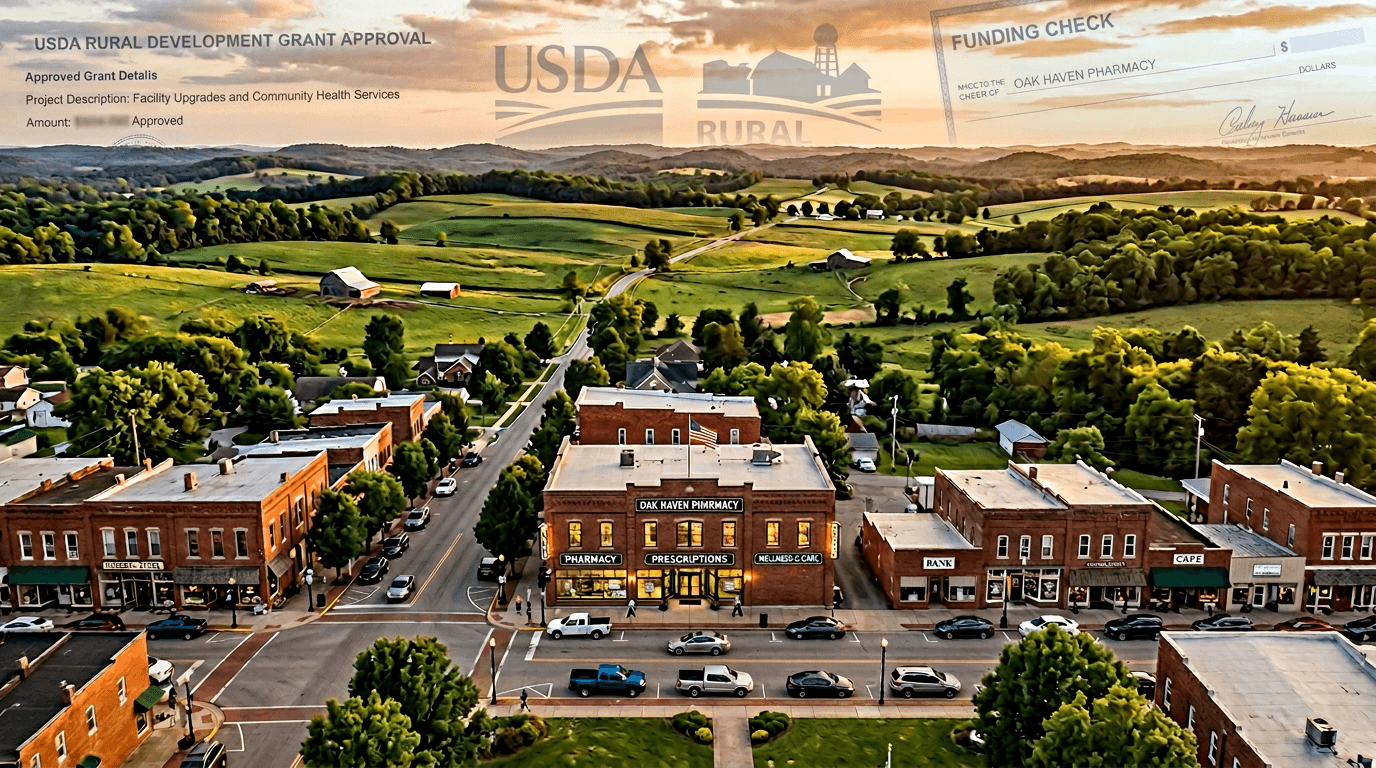
The USDA Is Funding Rural Health Infrastructure — Pharmacies Qualify
Most pharmacists don't think of the United States Department of Agriculture as a healthcare funder. But USDA Rural Development programs represent one of the most accessible and underutilized funding pathways for independent pharmacies looking to expand wellness services, upgrade facilities, or launch Food-as-Medicine programs in rural communities.
USDA doesn't fund "pharmacies" in the traditional sense. It funds rural community infrastructure — and a pharmacy that positions itself as a community health access point fits squarely within that definition.
The key insight: USDA grants for pharmacies are not about dispensing. They're about community health infrastructure, food access, rural business development, and essential service delivery.
Pharmacies that frame their transformation as rural community infrastructure — not retail expansion — unlock an entirely different tier of federal funding.
USDA Grant Programs Pharmacies Should Know
Community Facilities Direct Loan & Grant Program
This is the most directly applicable USDA grant program for pharmacies. The Community Facilities (CF) program provides funding to develop essential community facilities in rural areas and towns with populations up to 20,000.
What it covers:
- Construction, renovation, or expansion of healthcare facilities
- Equipment purchases for health service delivery
- Technology infrastructure for care coordination
- Facility improvements that expand community health access
Why pharmacies qualify: If your pharmacy is in a rural-designated area and you're expanding services beyond dispensing — adding clinical space, wellness program areas, metabolic health monitoring stations, or community education rooms — you can position the project as a community facility improvement.
Funding range: Grants can cover up to 75% of project costs for communities under 5,000 population with low median household income. Loans offer favorable terms with up to 40-year repayment periods.
Rural Business Development Grants (RBDG)
The Rural Business Development Grant program funds projects that benefit rural small businesses, including healthcare providers. This program splits into two categories:
- Enterprise grants — Fund the creation or expansion of rural small businesses
- Opportunity grants — Support community economic development, training, and technical assistance
How pharmacies use this: Fund business plan development for wellness program expansion, market feasibility studies for new service lines, workforce training for clinical pharmacy staff, or technical assistance for launching Food-as-Medicine programs.
Key advantage: These grants are often smaller ($10,000–$500,000) but have less competition and faster timelines than larger federal programs.
Rural Health and Safety Education Grants
Through the Rural Health and Safety Education (RHSE) program, USDA funds projects that provide education on health and safety to rural residents. A pharmacy launching a community metabolic health education program — covering nutrition, disease prevention, and wellness monitoring — aligns directly with this funding stream.
Community Food Projects Competitive Grants
For pharmacies building Food-as-Medicine programs, this grant category funds projects that increase food access and nutrition education in underserved communities. A pharmacy-based produce prescription program, nutrition counseling service, or community food education initiative can qualify.
Funding range: $25,000–$400,000 per project, with a one-to-one match requirement.
How to Determine Your Eligibility
Before investing time in any USDA application, confirm these foundational requirements:
- Rural designation — Use the USDA Rural Development eligibility map tool to confirm your pharmacy's location qualifies. Generally, areas with populations under 20,000 outside urbanized areas are eligible.
- Entity type — Most USDA programs require the applicant to be a public body, nonprofit, or tribal entity. Pharmacies operating as for-profit businesses may need to partner with a nonprofit sponsor or apply through a community organization.
- Service area need — Document the healthcare access gap in your community. USDA prioritizes projects serving areas with demonstrated need.
- Matching capacity — Many programs require a local match (typically 25–50%). Identify your match sources before applying.
Critical note for independent pharmacy owners: The for-profit structure of most pharmacies means you'll often need a nonprofit partner or fiscal sponsor to access USDA grant funding directly. This is where relationships with community foundations, rural health networks, or local nonprofit organizations become essential.
The RXI Wellness Pharmacy Model
The Wellness Pharmacy Network enables pharmacies to implement evidence-based programs that address nutrient deficiencies, reduce medication dependency, and improve long-term metabolic outcomes.
Positioning Your Pharmacy for USDA Funding
USDA program officers evaluate applications through an economic development and community impact lens, not a healthcare delivery lens. Your application language must reflect this:
- Don't say: "We want to expand pharmacy services"
- Say: "We're developing essential rural health infrastructure that reduces healthcare access barriers, creates local employment, and strengthens community resilience"
Building the Application Narrative
Community need: Lead with data. What is the nearest hospital distance? How many residents lack primary care access? What are the chronic disease rates in your county? USDA wants to see that your project addresses a documented community gap.
Economic impact: Quantify job creation, local spending, and economic multiplier effects. A pharmacy wellness program that adds two clinical staff, contracts with local food producers, and reduces emergency department utilization has a compelling economic story.
Sustainability: USDA wants to fund projects that continue operating after the grant period. Show your revenue model — memberships, employer contracts, cash-pay programs, insurance reimbursement — that sustains the program long-term.
Community support: Letters of support from local government, healthcare providers, employers, schools, and community organizations dramatically strengthen USDA applications. Start building these relationships now.
The USDA Application Process: What to Expect
USDA Rural Development applications move through your state Rural Development office. This is important — unlike many federal programs that go through a centralized process, USDA grants are managed at the state level.
Step 1: Contact your state Rural Development office. Introduce yourself, describe your project concept, and ask which programs might be the best fit. These offices are staffed with specialists who will guide you through the process.
Step 2: Submit a pre-application or letter of intent. Most programs accept preliminary inquiries before a full application. This saves time and allows you to refine your approach based on feedback.
Step 3: Develop the full application. Include your project narrative, budget, community need documentation, partnership letters, and sustainability plan.
Step 4: State-level review and scoring. Applications are scored against published criteria. Rural areas with greater need, smaller populations, and lower income levels receive priority points.
Typical timeline: 3–9 months from initial contact to funding decision, depending on the program and funding cycle.
Combining USDA Funding with Other Sources
The most successful pharmacy transformation projects layer multiple funding sources. USDA grants can combine with:
- HRSA rural health grants for clinical program development
- State rural health office funding for workforce development
- Community foundation grants for program launch costs
- Employer partnerships for ongoing revenue
- Cash-pay memberships for sustainability
A pharmacy might use a USDA Community Facilities grant for facility renovation, an HRSA grant for program staffing, and a community foundation grant for initial patient enrollment — creating a fully funded transformation package.
Dr. Kathy Campbell, PharmD
Founder, Wellness Pharmacy Network
With decades of experience transforming community pharmacies into wellness destinations, Dr. Campbell has pioneered the integration of Food-as-Medicine programs, metabolic health tracking, and preventive care models into independent pharmacy practice. She leads the RX Institute in its mission to equip pharmacists with the tools and training to become the front line of community health.
Your 30-Day USDA Activation Plan
Week 1: Confirm eligibility and identify programs. Use the USDA eligibility tool, review current program NOFAs (Notices of Funding Availability), and identify the 2–3 programs most relevant to your project.
Week 2: Contact your state Rural Development office. Schedule an introductory call. Ask about current funding priorities, upcoming deadlines, and any technical assistance available for first-time applicants.
Week 3: Build your project concept. Draft a one-page concept document: problem statement, proposed solution, community impact, budget estimate, and sustainability model. Share with your state RD contact for feedback.
Week 4: Assemble your support network. Secure letters of support from community partners. Identify a nonprofit fiscal sponsor if needed. Begin developing your full application package.
The Strategic Opportunity
USDA Rural Development distributes billions annually in loans and grants for rural community infrastructure. Yet very few pharmacies apply. The pharmacies that recognize themselves as essential rural health infrastructure — not just retail businesses — will access funding that their competitors don't even know exists.
"Our pharmacy serves as essential rural health infrastructure, expanding community access to preventive care, metabolic health monitoring, and nutrition-based wellness programs. We are positioned to strengthen rural community resilience through pharmacist-led care delivery."
This is the framing that turns a USDA program officer from skeptical to interested.
Download the USDA Grant Application Checklist for Pharmacies
Get actionable strategies and frameworks you can implement today.
Download Free Guide