Pharmacies as the Front Line of Prevention
The United States spends over $4.5 trillion annually on healthcare — and the vast majority of that spending treats diseases that could have been prevented, delayed, or mitigated with earlier intervention. The system is designed to react, not to prevent.
Pharmacies have the opportunity to change that equation.
No other healthcare setting combines the accessibility, trust, frequency of patient contact, and clinical expertise that community pharmacies provide. Patients visit their pharmacy more often than any other healthcare provider. They come without appointments. They come regularly. And they already trust the pharmacist.
The most impactful thing a pharmacy can do in the next decade is not fill more prescriptions. It is prevent the conditions that generate those prescriptions in the first place.
Preventive care pharmacy models transform this natural advantage into structured programs that identify risk early, intervene before disease takes hold, and track outcomes that prove the model works.
Why Prevention Belongs in Pharmacy
The case for pharmacy prevention programs is built on three pillars: access, frequency, and trust.
Access. Over 90 percent of Americans live within five miles of a community pharmacy. In rural and underserved areas, the pharmacy is often the only healthcare access point. No appointment is needed. Walk-in access is the default. This eliminates the access barriers — scheduling delays, transportation challenges, insurance requirements — that prevent patients from engaging with preventive care elsewhere.
Frequency. The average American visits a pharmacy far more often than a primary care provider. Each visit is a potential preventive care touchpoint — a brief conversation, a screening invitation, a health assessment offer. The cumulative impact of frequent, low-barrier touchpoints far exceeds an annual physical exam.
Trust. Pharmacists consistently rank among the most trusted healthcare professionals in national surveys. Patients share health concerns with their pharmacist that they may not raise with a physician. This trust is the foundation on which preventive care programs are built.
When you combine these three elements — access, frequency, and trust — with the pharmacist's clinical training in medication management, disease state knowledge, and patient counseling, the pharmacy becomes the most logical site for community-based prevention.
Core Preventive Care Models for Pharmacy
Several preventive health pharmacy services models have proven effective in community pharmacy settings. The right model depends on your community's health needs, your team's capabilities, and your strategic priorities.
Metabolic Health Screening
Metabolic syndrome — the cluster of conditions including elevated blood pressure, high blood sugar, abnormal cholesterol, and excess abdominal fat — affects over one-third of American adults. Most do not know they have it.
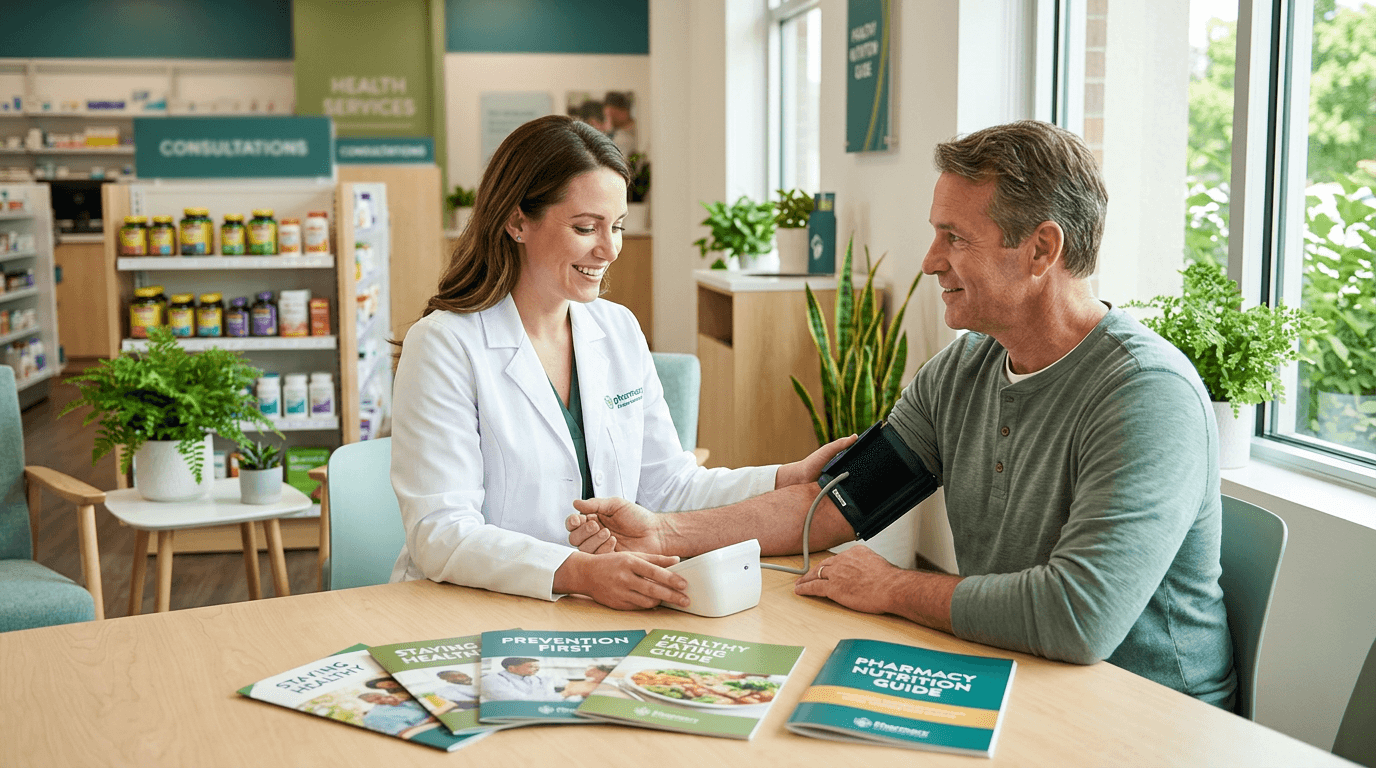
Pharmacy-based metabolic screening programs use body composition analysis, blood pressure measurement, point-of-care blood glucose and lipid testing, and waist circumference assessment to identify at-risk patients. The screening takes 15 to 20 minutes, requires no appointment, and produces actionable data immediately.
Patients identified as at-risk are enrolled in follow-up programs — nutrition counseling, lifestyle coaching, medication review, and longitudinal monitoring. The screening is the entry point. The program is the value.
Cardiovascular Risk Assessment
Heart disease remains the leading cause of death in the United States. Pharmacies can offer comprehensive cardiovascular risk assessments that include blood pressure screening, lipid panel testing, smoking cessation counseling, and medication therapy review for patients on cardiovascular medications.
Structured protocols allow pharmacists to calculate 10-year cardiovascular risk scores, counsel patients on modifiable risk factors, and refer to physicians when clinical thresholds are met. This positions the pharmacy as a proactive partner in cardiovascular prevention rather than a passive dispenser of statins and antihypertensives.
Diabetes Prevention Programs
The CDC's National Diabetes Prevention Program (DPP) is a structured lifestyle intervention that has been proven to reduce the risk of type 2 diabetes by 58 percent. Pharmacies can serve as DPP delivery sites, offering the program's curriculum of nutrition education, physical activity coaching, and behavioral counseling.
Pharmacy-based DPP programs leverage the pharmacist's medication expertise to provide integrated counseling that addresses both lifestyle and pharmacological factors — something few other DPP delivery sites can offer.
Nutrition and Food-as-Medicine Counseling
The connection between nutrition and chronic disease is irrefutable. Pharmacy-based nutrition counseling programs — from food-as-medicine consultations to produce prescription partnerships — address the dietary drivers of metabolic disease at the community level.
These programs are particularly impactful in food deserts and underserved communities where the pharmacy may be the most accessible source of health guidance. Grant funding for food-as-medicine programs is expanding rapidly, creating both clinical impact and revenue opportunity.
Immunization and Infectious Disease Prevention
Pharmacies have already proven their preventive care capability through immunization programs. Expanding beyond flu and COVID vaccines to include travel immunizations, hepatitis screening, HIV prevention (PrEP) counseling, and STI screening positions the pharmacy as a comprehensive prevention hub.
The RXI Wellness Pharmacy Model
The Wellness Pharmacy Network enables pharmacies to implement evidence-based programs that address nutrient deficiencies, reduce medication dependency, and improve long-term metabolic outcomes.
Building a Prevention Program That Generates Revenue
The most common objection to pharmacy wellness screening and preventive programs: "How do I get paid for this?"
The revenue model for pharmacy preventive care revenue has multiple pathways — and the pharmacies that diversify across them build the most sustainable programs.
Cash-Pay Wellness Programs
Patients pay directly for health assessments, body composition analysis, wellness consultations, and program enrollment. Price points typically range from $25 to $75 for individual assessments and $150 to $500 for multi-session programs. These services do not require insurance billing infrastructure and produce immediate revenue.
Employer Wellness Contracts
Local employers are spending significant money on employee health benefits — and they want measurable results. Pharmacies can contract with employers to provide on-site or in-pharmacy health screenings, wellness programs, and health coaching for their employees. Contracts are typically structured as per-employee-per-month fees or per-service payments.
Grant Funding
Federal, state, and foundation grant programs increasingly fund pharmacy-based prevention initiatives — particularly in rural and underserved communities. Programs that address metabolic health, diabetes prevention, food access, and health equity are strong candidates. Grant funding provides startup capital and demonstrates external validation of your model.
Clinical Service Billing
As pharmacist provider status expands, clinical preventive services become billable under medical insurance. Medication therapy management, chronic disease management, and certain screening services can generate reimbursement through Part D MTM programs, state Medicaid programs, and commercial payer contracts.
Value-Based Arrangements
Forward-thinking payers and ACOs are beginning to contract with pharmacies that can demonstrate preventive care outcomes — reduced hospitalizations, improved medication adherence, and better chronic disease control. These arrangements pay for results, and pharmacies with outcomes data have the strongest negotiating position.
Designing Your Prevention Program: The Framework
Launching pharmacy community prevention services requires a structured approach. Follow this framework to build a program that is clinically sound, operationally sustainable, and financially viable.
Step 1: Identify Your Community's Need
What are the dominant health challenges in your patient population? Review your prescription data — what conditions are you dispensing the most medications for? Talk to local hospitals about their most common admissions. Check county health rankings for your area's leading health issues. Your program should address a real, documented community health need.
Step 2: Define the Intervention
Design a structured program with clear protocols:
- Entry criteria — Who is eligible? How do patients enroll?
- Assessment protocol — What measurements and screenings are performed at intake?
- Intervention structure — What does the program include? How many sessions? What content is delivered?
- Follow-up schedule — When are patients reassessed? What triggers additional intervention?
- Graduation criteria — What defines program completion?
Step 3: Build Your Measurement Framework
Define the outcomes you will track before launching the program. Baseline measurements are useless after the fact. For every enrolled patient, capture:
- Baseline clinical measurements (blood pressure, body composition, glucose, lipids)
- Program engagement data (sessions attended, content completed, follow-ups kept)
- Follow-up clinical measurements at defined intervals
- Patient-reported outcomes (satisfaction, behavior changes, quality of life)
Step 4: Establish Revenue Pathways
Determine how the program generates revenue. Start with the most accessible pathway — typically cash-pay services or employer contracts — and add complexity over time. Do not wait for insurance billing infrastructure to launch.
Step 5: Train and Launch
Train your team on program protocols, measurement procedures, patient communication, and documentation requirements. Pilot with a small cohort of 10 to 20 patients. Refine based on early experience. Scale after you have proven the model works.
Overcoming the Prevention Paradox
Prevention faces a fundamental challenge: success is invisible. When a patient does not develop diabetes, there is no dramatic event to celebrate. When a community's cardiovascular risk declines, there is no headline.
This is why measurement matters so profoundly in preventive care. Without data, prevention feels like nothing happened. With data, prevention becomes the most powerful story in healthcare.
Track and communicate:
- Patients screened — Total community members who received preventive assessments
- Risk factors identified — Conditions caught early that would have progressed without intervention
- Clinical improvements — Blood pressure reductions, body composition changes, glucose improvements
- Program engagement — Enrollment, attendance, and completion rates
- Projected impact — Estimated healthcare costs avoided, hospitalizations prevented, quality-adjusted life years gained
These numbers tell the story that justifies your program to funders, partners, payers, and the community itself.
Dr. Kathy Campbell, PharmD
Founder, Wellness Pharmacy Network
With decades of experience transforming community pharmacies into wellness destinations, Dr. Campbell has pioneered the integration of Food-as-Medicine programs, metabolic health tracking, and preventive care models into independent pharmacy practice. She leads the RX Institute in its mission to equip pharmacists with the tools and training to become the front line of community health.
Your Prevention Program Launch Plan
Week 1: Community Health Assessment — Review your prescription data, county health rankings, and local hospital reports. Identify the one or two health issues your community needs addressed most urgently.
Week 2: Program Design — Using the framework above, design a structured prevention program targeting your identified health need. Define protocols, measurement points, and patient flow.
Week 3: Revenue and Partnership Development — Price your cash-pay services. Identify two to three local employers for outreach. Research grant opportunities. Connect with your state pharmacy association for billing guidance.
Week 4: Pilot Launch — Train your team. Enroll your first 10 to 15 patients. Capture baseline data for every participant. Begin delivering your intervention and tracking engagement.
Month 2 to 3: Measure and Refine — Collect follow-up data. Calculate early outcomes. Adjust protocols based on what you learn. Begin building your outcomes report.
Month 4 and Beyond: Scale and Sustain — Expand enrollment. Add revenue pathways. Share your outcomes story with the community, partners, and funders. Build toward a sustainable, multi-pathway prevention program that positions your pharmacy as the front line of community health.
"The pharmacy that prevents disease is more valuable than the pharmacy that treats it. Every screening performed, every risk factor identified, every patient enrolled in a prevention program is an investment in a healthier community — and a more sustainable pharmacy business."
Download the Preventive Care Program Design Guide
Get actionable strategies and frameworks you can implement today.
Download Free Guide